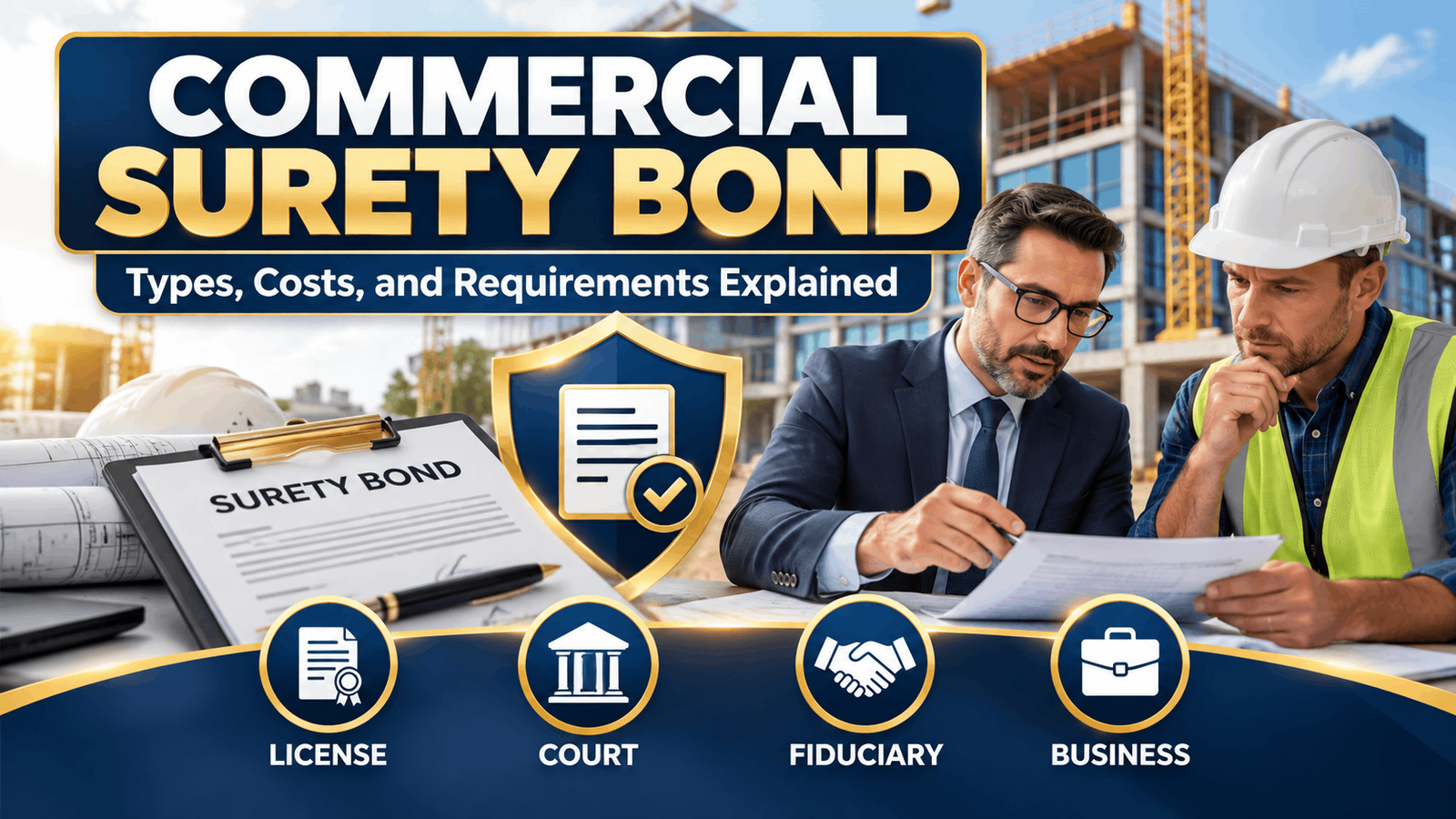
Commercial Surety Bond: Types, Costs, and Requirements Explained
A commercial surety bond may be required when a business or individual must meet a licensing, regulatory, court, permit, or other legal obligation. Although people sometimes think of surety bonds as standard insurance, they work differently because they involve three parties and guarantee a specific obligation.
For U.S. businesses, bond requirements can vary by state, industry, profession, and government agency. Therefore, identifying the exact bond you need should come before comparing prices or applying for coverage.
HHAS provides information about business bonding on its Insurance Bonds page. Businesses that already know they need a bond can also use the HHAS Insurance Bond Quote form to begin the quote process. hhasinsurance.com
What Is a Commercial Surety Bond?
If you are asking what is a commercial surety bond, the easiest place to start is with the three parties involved.
The principal is the business or individual required to obtain the bond. The obligee is the government agency, court, organization, or other party requiring it. Finally, the surety is the company that provides the guarantee.
The Surety & Fidelity Association of America explains that commercial surety bonds are commonly associated with licensing and obligations required by government bodies, courts, financial institutions, and private organizations. Examples include license and permit bonds, court bonds, and fiduciary bonds. Surety
For additional information, businesses can review the Surety & Fidelity Association of America guide to surety bonds.
Because the bond guarantees a specific obligation, its purpose is different from a typical business insurance policy. As a result, understanding what the obligee requires is essential before purchasing a bond.
How Does a Commercial Surety Bond Work?
Suppose a government agency requires a business to obtain a bond before issuing a professional license.
In that situation, the business is the principal. Meanwhile, the agency requiring the bond is the obligee. The surety then issues the bond that backs the principal’s obligation according to the bond terms.
If the principal fails to meet that obligation and a valid claim is made, the surety responds according to the bond terms and applicable law.
However, this does not mean a surety bond works exactly like ordinary insurance. Traditional insurance generally protects the insured against covered losses. Surety, on the other hand, centers on guaranteeing the principal’s obligation to another party.
Therefore, business owners should review the actual bond form and requirements rather than assuming all bonds provide the same protection.
Commercial Surety Bonds vs. Contract Surety Bonds
Commercial and contract surety bonds are related, but they are not the same.
According to the U.S. Small Business Administration, contract bonds help ensure that the terms of a specific contract are fulfilled. Commercial bonds, by comparison, generally address compliance with applicable laws and regulations. Small Business Administration
The SBA surety bond resource provides additional information about this distinction.
Contract surety is especially common in construction. For example, bid, payment, and performance bonds are major contract bond categories.
Commercial surety has a broader regulatory focus. For instance, a business might need a bond to obtain a license, satisfy a permit requirement, fulfill a court obligation, or meet another legal requirement.
This distinction matters because applying for the wrong bond can delay licensing, permitting, or another business process. Therefore, always start with the exact requirement provided by the obligee.
Common Commercial Surety Bond Types
There are many commercial surety bond types, and the right one depends on the obligation being guaranteed.
Some of the most common categories include license and permit bonds, court bonds, fiduciary bonds, and public official bonds. However, specialized commercial bonds also exist for particular industries and obligations. Surety
License and Permit Bonds
Government agencies may require license and permit bonds before allowing a business or professional to conduct certain activities.
For example, some occupations and regulated industries require a bond as part of the licensing process. However, the exact requirement depends on the jurisdiction and activity involved.
The SFAA explains that license and permit bonds can be required by state law, municipal ordinance, regulation, or, in some cases, the federal government. Surety
Therefore, businesses should confirm the required amount and bond form directly with the licensing authority.
Court Bonds
Courts may require bonds in certain legal proceedings.
For example, judicial bonds can apply when a party seeks a legal remedy that requires a bond. Depending on the proceeding, examples can include appeal, injunction, attachment, and other court-related bonds. Surety
Because court requirements can be very specific, applicants should obtain the required form and instructions directly from the court or their legal adviser.
Fiduciary Bonds
A court may also require a fiduciary bond when someone is responsible for managing assets or duties on behalf of another person or estate.
Depending on the circumstances, fiduciary roles can include administrators, executors, guardians, trustees, receivers, and similar positions. Surety
In these situations, the bond generally supports the faithful performance of the duties established by the court.
Public Official Bonds
Some public officials may be required to obtain bonds before or while serving in office.
The specific requirement depends on the position and jurisdiction. Therefore, an official should confirm the required bond form, amount, and conditions with the appropriate government authority.
Other Commercial Bonds
In addition, commercial surety can include specialized bonds created for particular regulatory, financial, or business obligations.
Because requirements differ, there is no single commercial bond that works for every business. Instead, the correct bond must match the obligation being guaranteed.
What About Bid, Payment, and Performance Bonds?
Business owners often use the term “business bond” broadly. However, bid, payment, and performance bonds are generally classified as contract surety bonds rather than commercial surety bonds.
HHAS identifies bid, payment, performance, and ancillary bonds among the common bond types used by business owners on its Insurance Bonds page. hhasinsurance.com
The SBA also identifies bid, payment, performance, and ancillary bonds within its Surety Bond Guarantee Program. Notably, the SBA states that its program guarantees eligible contract bonds but does not guarantee commercial bonds. Small Business Administration
Therefore, a contractor seeking a performance bond may face different requirements from a business seeking a license or permit bond.
How Much Does a Commercial Surety Bond Cost?
There is no universal price for a commercial surety bond.
Instead, the cost depends on the particular bond, required amount, obligation, applicant, and underwriting requirements.
Several factors may influence pricing, including:
- Required bond amount
- Type of bond
- Bond term
- Applicant’s credit profile when applicable
- Financial information when required
- Business experience
- Nature of the obligation
- Previous bond claims when relevant
- State or jurisdiction
- Underwriting requirements
However, not every factor applies to every bond. Some bonds may involve a relatively straightforward application, while others can require more detailed underwriting.
As a result, requesting a quote for the exact bond requirement is more useful than relying on a generic price estimate.
Bond Amount vs. Bond Premium
One common source of confusion is the difference between the bond amount and the bond premium.
The bond amount is the amount specified by the bond requirement. In contrast, the premium is the amount charged to obtain the bond.
For example, an agency may require a particular bond amount as a condition of licensing. However, that does not automatically mean the applicant pays the full bond amount as the purchase price.
Instead, the surety determines the premium based on its underwriting process and the specific bond.
Therefore, when comparing quotes, make sure you understand both the required bond amount and the premium you will actually pay.
What Can Affect Commercial Surety Bond Costs?
Several factors can influence the cost and availability of a bond. Nevertheless, underwriting varies among bond types and sureties.
Type of Bond
First, the surety needs to understand the obligation being guaranteed.
A license bond, for example, presents a different obligation from a fiduciary or court bond. Consequently, underwriting requirements can differ significantly.
Required Bond Amount
The amount required by the obligee can also affect underwriting.
However, businesses should never guess this amount. Instead, obtain the exact requirement from the agency, court, or organization requesting the bond.
Credit and Financial Information
Depending on the bond, a surety may consider personal or business credit information.
In addition, some applications may require financial statements or other supporting documents. More complex obligations can involve a more detailed review.
Business Experience
For some bonds, experience may also be relevant to underwriting.
For example, a surety may request information about the company’s history or experience with the type of obligation being bonded. However, the exact requirements depend on the bond.
Previous Claims
Past bond claims may also be considered in some underwriting decisions.
Therefore, applicants should answer questions about previous bonds and claims accurately when completing an application.
Commercial Surety Bond Requirements
Requirements vary because the obligee usually determines what bond is needed.
Before applying, businesses should confirm:
- Exact bond type
- Required bond amount
- Name of the obligee
- Official bond form
- Effective date
- License or permit number, when applicable
- State or jurisdiction
- Filing instructions
- Renewal requirements
After that, the surety or agency may request additional information to evaluate the application.
For example, an applicant may need to provide business details, ownership information, credit authorization, financial documents, or other records. However, the documents required depend on the particular bond.
Getting the official requirements first can prevent delays and reduce the chance of applying for the wrong bond.
Federal Surety Bond Requirements
Federal bond requirements deserve special attention.
The U.S. Department of the Treasury’s Bureau of the Fiscal Service administers the federal surety bond program. In addition, Treasury maintains Department Circular 570, which lists companies holding certificates of authority as acceptable sureties on federal bonds. Bureau of the Fiscal Service
The 2026 revision became effective on August 1, 2026. Treasury also notes that interim changes may occur, so businesses dealing with federal bond requirements should check the current information rather than relying on an older list. Bureau of the Fiscal Service
You can review Treasury Department Circular 570 or the current Treasury list of certified companies when a federal bond is involved.
Meanwhile, state and local requirements may differ. Therefore, always confirm the rules for your specific obligation and jurisdiction.
What Is Commercial Surety Bond Insurance?
The phrase commercial surety bond insurance is commonly used when people search for bonding products. However, surety bonds operate differently from standard insurance policies.
Traditional insurance generally transfers specified risks to an insurer according to the policy terms. Surety, by comparison, involves the principal, obligee, and surety.
Therefore, a required surety bond should not automatically be treated as a substitute for general liability, commercial property, workers’ compensation, or another business insurance policy.
Businesses evaluating broader protection can also review the HHAS Business Insurance page. hhasinsurance.com
How to Apply for a Commercial Surety Bond
The process becomes easier when you start with the exact bond requirement.
1. Confirm Which Bond You Need
First, contact the agency, court, licensing authority, or organization requiring the bond.
Ask for the exact bond name, required amount, and official form. In addition, confirm whether there are special filing instructions.
2. Verify the Bond Amount
Next, verify the amount directly with the obligee.
Requirements can vary, so avoid selecting an amount based on another business’s bond or an online example.
3. Gather Your Information
Then, prepare the information needed for the application.
This may include your legal business name, address, ownership information, license details, bond amount, and reason for the bond. Depending on the bond, additional underwriting documents may also be required.
4. Submit the Application
After gathering the required information, submit a complete application.
Accurate information can help prevent unnecessary back-and-forth during underwriting. Moreover, responding promptly to requests for additional documentation can keep the process moving.
5. Review the Quote
Once you receive a quote, check more than the premium.
Confirm the principal’s legal name, obligee, bond amount, effective date, term, and other important information.
6. Complete the Required Filing
Finally, determine where the completed bond must be filed.
Depending on the requirement, filing may involve a licensing agency, government department, court, or another organization. Therefore, follow the obligee’s instructions carefully.
Choosing a Commercial Surety Bond Agency
A commercial surety bond agency should help you understand the bond requirement rather than simply focus on price.
Before moving forward, consider whether the agency can help clarify:
- Bond type
- Required amount
- Application process
- Underwriting documentation
- Effective date
- Renewal terms
- Filing requirements
- Available surety options
For federal bonds, additional federal requirements can apply. Therefore, applicants should also confirm that the surety is acceptable for the specific federal obligation.
If you already have your bond requirements, HHAS provides an Insurance Bond Quote form where businesses can submit information to begin the quote process. hhasinsurance.com
Best Way to Compare Commercial Surety Bond Quotes
The best way to compare commercial surety bond quotes is to compare quotes based on the same bond requirement.
First, verify the required bond type and amount. Next, make sure each quote is based on the same obligee, bond form, and term.
Then compare factors such as:
- Premium
- Bond amount
- Bond term
- Renewal conditions
- Underwriting requirements
- Collateral requirements, if applicable
- Additional fees or conditions
- Filing requirements
- Surety company
Price matters. However, the lowest-priced option is not useful if the bond does not satisfy the obligee’s requirements.
For federal bonds, businesses can also check Treasury’s List of Certified Companies to review currently authorized companies. Bureau of the Fiscal Service
Why You Should Confirm Requirements Before Buying
A business may know that it needs a bond without knowing exactly which bond it needs.
Unfortunately, applying for the wrong bond can create delays. Therefore, confirm the requirement before completing an application.
Ask the obligee for the official bond form whenever one is available. In addition, confirm the amount, effective date, filing method, and renewal requirements.
Once you have that information, an insurance or surety professional has a much clearer starting point for helping you obtain the correct bond.
Surety Bonds and Business Insurance Serve Different Purposes
A surety bond should not automatically replace business insurance.
Instead, the two serve different purposes.
For example, a business might need a license bond to meet a regulatory requirement. At the same time, it may need separate insurance policies to address risks associated with its operations.
Therefore, business owners should evaluate their bonding and insurance needs separately.
HHAS provides additional information about commercial coverage on its Business Insurance page and information about bonds on its Insurance Bonds page. hhasinsurance.com
Frequently Asked Questions About Commercial Surety Bonds
What is a commercial surety bond?
A commercial surety bond is a three-party arrangement involving a principal, obligee, and surety. Generally, these bonds guarantee a specific licensing, regulatory, court, permit, or other obligation. Common examples include license and permit bonds, court bonds, and fiduciary bonds. Surety
Who may require a commercial surety bond?
Government agencies, courts, licensing authorities, financial institutions, and other organizations may require commercial bonds. However, requirements depend on the activity, industry, and jurisdiction.
What are common commercial surety bond types?
Common types include license and permit bonds, court bonds, fiduciary bonds, and other specialized commercial bonds. Because requirements differ, businesses should confirm the exact bond with the obligee. Surety
How much does a commercial surety bond cost?
There is no single price for every commercial bond. Instead, cost can depend on the bond type, required amount, applicant, jurisdiction, term, and underwriting requirements.
Is the bond amount the same as the premium?
No. The bond amount is the amount specified by the bond requirement, while the premium is the amount charged to obtain the bond. Therefore, businesses should distinguish between these two figures when comparing quotes.
Is commercial surety bond insurance the same as business insurance?
No. Although surety is part of the insurance industry, it operates as a three-party guarantee. Traditional business insurance, meanwhile, generally protects the insured against covered risks according to the policy.
Are performance and payment bonds commercial surety bonds?
Generally, no. Bid, performance, and payment bonds are typically categorized as contract surety bonds. They are particularly common in construction and contracting. Small Business Administration
Does the SBA guarantee commercial surety bonds?
No. The SBA states that its Surety Bond Guarantee Program guarantees eligible contract bonds but does not guarantee commercial bonds. Small Business Administration
How do I know which bond my business needs?
Start by contacting the organization requiring the bond. Ask for the exact bond type, amount, official form, effective date, and filing instructions. Then use those details when requesting a quote.
Where can I request an insurance bond quote?
Businesses can use the HHAS Insurance Bond Quote form to provide information and begin the quote process. hhasinsurance.com
Find the Right Bond for Your Business
A commercial surety bond can help a business satisfy a licensing, regulatory, court, permit, or other formal obligation. However, the right bond depends on exactly what the obligee requires.
Therefore, begin by confirming the bond type, amount, form, effective date, and filing requirements. Next, gather the information needed for underwriting. Finally, compare quotes based on the same requirements instead of price alone.
HHAS provides additional information through its Insurance Bonds resource. When you are ready to explore a bond quote, you can also use the HHAS Insurance Bond Quote form