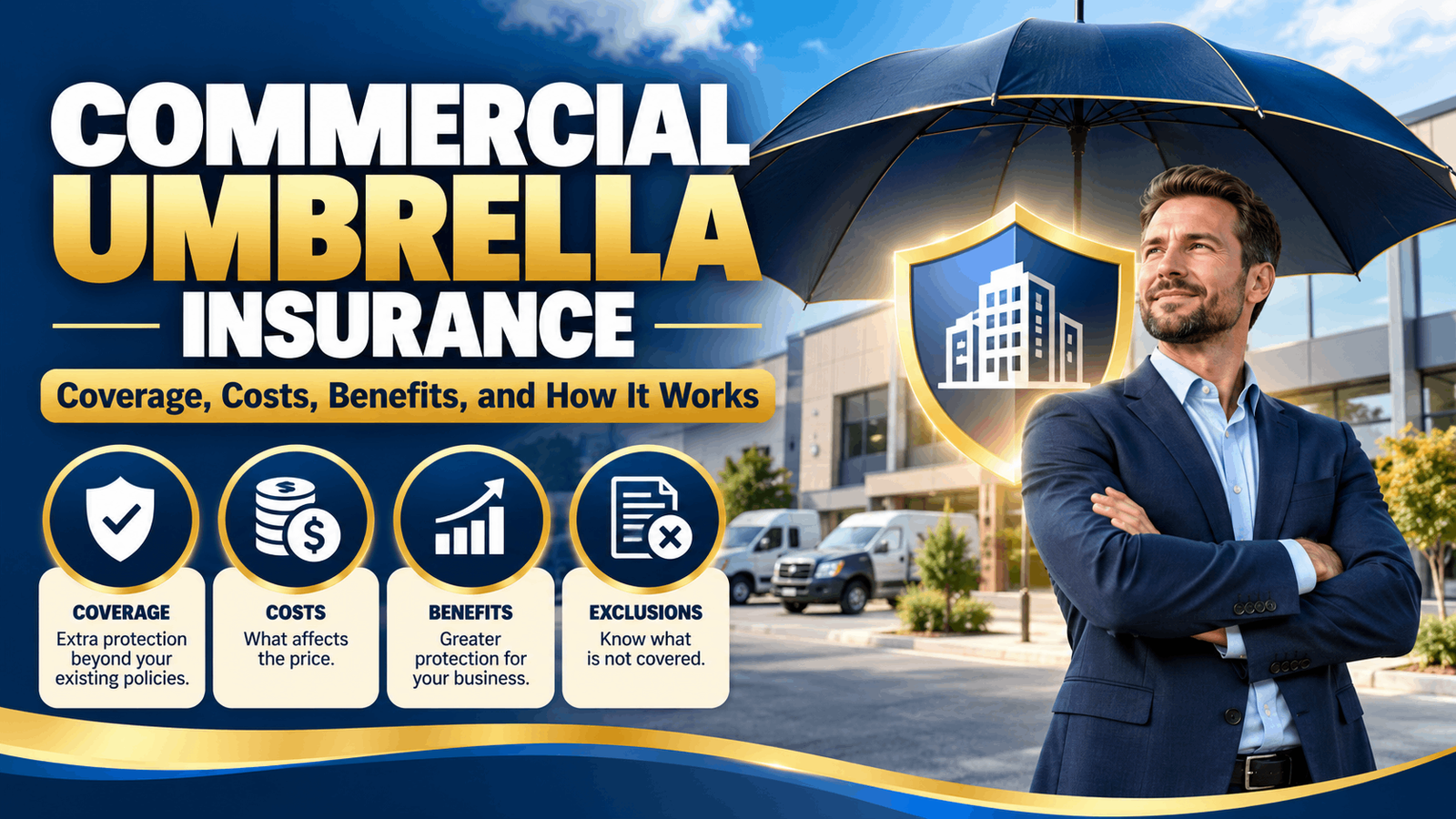
Commercial umbrella insurance helps protect a business when a covered liability claim exceeds the limits of its underlying insurance. A serious injury, major vehicle accident, or costly lawsuit can create expenses far beyond what a standard liability policy will pay. As a result, even an established company may face a financial shortfall after a single incident.
However, an umbrella policy does not cover every business loss. It generally works above specified liability policies, and its exclusions, limits, and coverage conditions matter. Before purchasing extra protection, business owners should understand where it applies and how much it could cost.
This guide explains commercial umbrella coverage, its benefits, common exclusions, pricing factors, and how to compare policies in the United States.
What Is Commercial Umbrella Insurance?
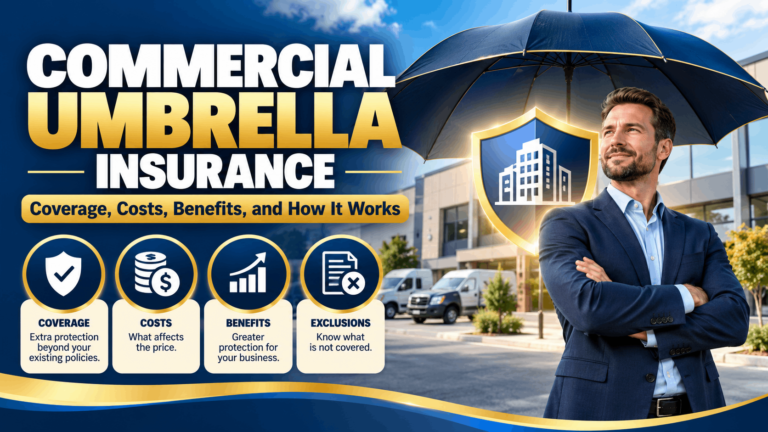
Commercial umbrella insurance is a type of business liability protection that may pay eligible claims after the limits of specified underlying policies have been exhausted. In other words, it adds another layer of liability coverage above insurance a company already carries.
For example, a business might have a $1 million per-occurrence general liability limit. If a covered claim exceeds that amount, a qualifying umbrella policy could respond to the additional covered damages, subject to its own terms and limits.
According to the Insurance Information Institute’s business liability guide, commercial umbrellas commonly sit above general liability, business auto liability, and employers’ liability coverage. Still, the exact underlying policies must be identified in the umbrella contract.
Commercial Umbrella Insurance Coverage Basics
Think of an umbrella as an additional layer, not a replacement for primary coverage. First, an eligible underlying policy responds to a covered liability claim. Then, if that policy’s applicable limit is exhausted, the umbrella may pay additional covered amounts up to its own limit.
Some umbrella contracts can also cover certain liability risks not included in the underlying policy. Nevertheless, that broader protection is not automatic and may require a self-insured retention, which is an amount the business must pay before the umbrella responds.
How Does Commercial Umbrella Insurance Work?
The easiest way to understand the coverage is to follow a hypothetical claim from the first insurer to the umbrella insurer.
Example: A Large Customer Injury Claim
Imagine a customer suffers a serious injury at a business location. After investigation, the business is legally responsible for a covered claim totaling $1.8 million. For simplicity, assume the underlying general liability policy has a $1 million applicable limit and the business has a $2 million umbrella limit.
| Illustrative Claim Calculation | Amount |
|---|---|
| Covered liability claim | $1,800,000 |
| Underlying general liability payment | $1,000,000 |
| Remaining covered amount | $800,000 |
| Potential umbrella payment | $800,000 |
In this simplified example, the umbrella could cover the additional $800,000 if all coverage conditions are met. Without eligible excess protection, the business might have to fund that amount itself.
Actual claims can be more complicated. For instance, defense expenses may be handled inside or outside the limits, and exclusions or settlement terms may change the payment. Therefore, do not assume the umbrella always pays every dollar above the primary policy limit.
Underlying Limits and Policy Requirements
Umbrella insurers commonly require minimum liability limits on specified underlying policies. Additionally, the business may need to maintain those limits throughout the policy term.
If a primary policy lapses or its limits fall below the required amount, the umbrella may not simply replace the missing insurance. Instead, the company could remain responsible for part of a covered loss. Review the schedule of underlying insurance and any maintenance requirements before binding coverage.
What Does a Commercial Umbrella Insurance Policy Cover?
A commercial umbrella insurance policy typically focuses on substantial third-party liability claims. Coverage depends on the underlying insurance, the umbrella wording, and the cause of the loss.
General Liability Claims
An umbrella may provide additional limits for eligible bodily injury or property damage claims arising from business premises or operations. For example, a customer injury at a store could lead to damages exceeding the general liability limit.
Likewise, certain product-related or completed-work liability claims may qualify when the underlying coverage and umbrella both apply. However, products-completed operations terms and aggregate limits should be reviewed separately.
Commercial Auto Liability
Businesses with delivery vans, service trucks, or other covered vehicles may face expensive third-party injury claims. If an eligible crash exhausts the commercial auto liability limit, an umbrella may provide another layer of protection.
Importantly, this is liability coverage for harm to others. It does not automatically repair the company’s own vehicle or replace collision coverage.
Employers’ Liability, When Included
Some commercial umbrellas extend above the employers’ liability portion of a workers’ compensation policy. That is different from paying statutory workers’ compensation benefits, which an umbrella generally does not replace.
Because the distinction is important, confirm whether employers’ liability is scheduled as underlying coverage and whether any special exclusions apply.
Defense Costs and Certain Additional Exposures
Depending on the form, an umbrella may contribute to legal defense costs for covered claims. However, defense provisions differ, including whether expenses reduce available policy limits and which insurer controls the defense.
Certain forms may offer broader liability coverage than the underlying policies. Still, never assume professional negligence, employment disputes, cyber incidents, or pollution claims are included without an express provision or endorsement.
What Commercial Umbrella Insurance Does Not Cover
Umbrella protection has meaningful boundaries. Generally, it does not cover damage to the business’s own buildings, equipment, or inventory merely because those losses are expensive.
Common exclusions or limitations may involve:
- Damage to property owned by the insured business
- Intentional or expected injury and certain unlawful acts
- Professional errors and omissions, unless specifically covered
- Employment practices claims, unless expressly included
- Cyber incidents, data breaches, or technology liability
- Pollution-related claims and certain hazardous activities
- Workers’ compensation benefits owed under workers’ compensation law
- Contractual liabilities beyond what the policy agrees to cover
For example, a warehouse fire that destroys the company’s inventory is primarily a commercial property insurance issue, not an umbrella liability claim. On the other hand, if a covered incident also damages a neighboring business’s property, third-party liability may be relevant.
The Insurance Information Institute notes that many umbrellas exclude specialized liabilities, including professional and employment-related claims. Consequently, a business with those exposures may need separate policies rather than relying on its umbrella.
Commercial Umbrella Insurance vs. Excess Liability Insurance
These terms are often used together, but they are not always interchangeable. Both can provide higher liability limits after underlying coverage is exhausted.
An excess liability policy may follow the coverage terms of a particular underlying policy or group of policies. By contrast, some umbrella forms can extend across multiple liability policies and may include limited additional coverage.
| Feature | Commercial Umbrella | Excess Liability |
|---|---|---|
| Primary purpose | Adds liability protection above specified policies | Adds liability limits above scheduled coverage |
| Underlying policies | May sit above several liability policies | May apply above one or several, depending on form |
| Potentially broader coverage | Possible, not guaranteed | Often follows underlying terms, but forms vary |
| Key review item | Exclusions, retention, and underlying schedule | Follow-form wording, exclusions, and attachment point |
Ultimately, the actual contract matters more than the label. Ask the insurer or agent to explain whether a proposed policy is follow-form excess coverage or provides any genuine umbrella-specific extensions.
Commercial Umbrella Insurance Benefits for Business Owners
The main benefit is a higher amount of available protection against eligible severe liability claims. Additionally, the policy may help a business satisfy contractual insurance requirements or manage risks associated with growth.
Greater Protection Against Large Claims
Even a single lawsuit can exceed a company’s primary liability limit. With an appropriate umbrella, more of the covered exposure may be insured rather than paid from business assets.
Support for Business Contracts
Some clients, landlords, or project owners require higher liability limits before awarding work. An umbrella can sometimes help meet those limits when the contract and insurer accept the coverage arrangement.
However, a certificate of insurance does not expand coverage. Check the policy wording and any required additional insured endorsements rather than relying on the certificate alone.
Flexibility as Operations Expand
A company may add locations, vehicles, employees, or higher-value contracts over time. Consequently, its potential liability exposure may change even when its existing general liability limit stays the same.
An annual review can help identify whether higher limits are appropriate. Nevertheless, purchasing an umbrella is only one part of managing risk; safety practices and appropriate primary policies still matter.
Commercial Umbrella Insurance Cost: What Determines the Premium?
Commercial umbrella insurance cost depends on the business’s exposure and the coverage requested. Therefore, a single advertised price cannot accurately represent every company in the United States.
Insurers may consider the following factors:
| Pricing Factor | Why It Matters |
|---|---|
| Industry and operations | Some activities present greater liability exposure |
| Annual revenue and business size | May indicate the scale of operations |
| Vehicles and driving exposure | Commercial fleets can increase potential auto liability |
| Claims history | Past losses may affect underwriting and pricing |
| Umbrella limit | Higher limits generally provide more potential protection |
| Underlying insurance | Required limits and policy types influence the arrangement |
| Locations and jurisdictions | Exposures and insurance rules differ |
| Safety and risk controls | Insurers may evaluate loss-prevention practices |
Is a $1 Million Umbrella Enough?
A $1 million umbrella limit may be appropriate for some businesses, but it is not a universal recommendation. For example, a small office with limited public exposure faces different risks from a contractor operating heavy equipment or a delivery business with multiple vehicles.
Instead of selecting a limit by habit, consider plausible severe claims, existing insurance limits, contracts, and what the company could afford to retain. An insurance professional can help evaluate whether $1 million, $2 million, or a different limit matches those exposures.
Compare the Total Coverage, Not Just the Quote
Two proposals with the same umbrella limit may offer different protection. For instance, one may include employers’ liability as an underlying policy, while another may exclude it.
Similarly, self-insured retentions, defense provisions, and aggregate limits can affect the value of a quote. As a result, the lowest premium is not necessarily the best choice.
Who Needs Commercial Umbrella Insurance?
Businesses with meaningful exposure to large third-party claims may want to consider an umbrella. The need is not determined solely by revenue or company size.
Examples include:
- Contractors and trades: Jobsite injuries, property damage, and contractual limit requirements can create substantial liability concerns.
- Retail stores and restaurants: Public foot traffic may increase the chance of injury claims.
- Delivery and transportation businesses: Vehicle accidents can produce serious third-party losses.
- Property owners and managers: Premises liability exposures may warrant higher limits.
- Manufacturers and distributors: Product-related claims may involve multiple injured parties or substantial damage.
By contrast, some very small businesses with limited operations may have lower exposure. Even then, the right decision depends on their contracts, existing policies, and ability to absorb a large uninsured claim.
How to Choose the Right Commercial Umbrella Insurance Policy
Start with the policies you already own rather than shopping for an umbrella in isolation. This makes it easier to identify the liability limits and exposures that need attention.
- List your underlying policies. Include general liability, commercial auto, and employers’ liability when applicable.
- Review existing limits. Note per-occurrence and aggregate limits, along with any client or lease requirements.
- Identify severe-loss scenarios. Consider injuries, vehicle accidents, product liability, and other risks relevant to your operations.
- Compare exclusions and retentions. Confirm which policies the umbrella follows and what remains uninsured.
- Ask about defense costs. Find out who handles a large claim and whether legal expenses reduce the limit.
- Revisit coverage after changes. New contracts, vehicles, or locations may justify another review.
For additional background, the Insurance Information Institute’s guide to businessowners policies explains how umbrella and excess protection can supplement a business’s primary insurance.
How to Request a Commercial Umbrella Insurance Quote
To obtain a useful commercial umbrella insurance quote, prepare basic details about your company and current coverage. In particular, insurers may ask for your industry, operations, revenue, locations, vehicles, and claims history.
Also, have copies of your existing liability policy declarations available. These documents help the insurer identify underlying limits and any required changes before issuing an umbrella.
When comparing proposals, ask the following questions:
- Which underlying policies are covered?
- What minimum limits must I maintain?
- Are there exclusions specific to my industry?
- Does the policy include a self-insured retention?
- How are defense costs and aggregate limits handled?
- Can the coverage meet my contract’s insurance requirements?
Finally, request written explanations of any important differences between quotes. Clear answers now can prevent misunderstandings after a claim.
Explore Business Liability Protection With HHAS Insurance
HHAS Insurance Services Inc. discusses commercial umbrella protection on its business insurance page, alongside general liability, commercial auto, and other business coverage options. The agency also provides information about umbrella insurance.
If your business is reviewing liability limits, you can request a business insurance quote or contact HHAS Insurance to discuss available options. You can also visit its umbrella insurance quote page and confirm which commercial options are available for your business.
Specific terms, eligibility, and availability depend on the insurer, state, and business operations.
Frequently Asked Questions About Commercial Umbrella Insurance
What Is Commercial Umbrella Insurance Used For?
It is primarily used to provide additional liability limits when a covered claim exceeds the applicable underlying insurance. Depending on the policy, certain additional liability exposures may also be included.
How Does Commercial Umbrella Insurance Work With General Liability?
First, general liability responds to an eligible claim under its terms. If the applicable limit is exhausted, a qualifying umbrella may pay additional covered damages, subject to its own conditions and limit.
Does Commercial Umbrella Insurance Cover Employees?
It may extend above employers’ liability coverage when that policy is included in the underlying schedule. However, an umbrella does not replace statutory workers’ compensation benefits.
Is Commercial Umbrella Insurance Required by Law?
There is no universal requirement for every U.S. business to purchase a commercial umbrella. Nevertheless, a contract, landlord, or project owner may require higher liability limits that an umbrella can help provide.
Can an Umbrella Cover Professional Liability or Cyber Claims?
Do not assume it does. Many forms exclude these exposures unless specifically endorsed or written to include them. Therefore, businesses should review separate professional liability or cyber coverage when relevant.
How Much Commercial Umbrella Insurance Do I Need?
The appropriate limit depends on the company’s operations, underlying policies, contracts, and potential claim severity. Instead of choosing a fixed amount for every business, compare realistic exposures with the limits you already carry.
Is Commercial Umbrella Insurance the Same as a BOP?
No. A businessowners policy generally combines certain property and liability coverages. By contrast, a commercial umbrella adds liability protection above specified underlying policies and does not replace a BOP.
Final Thoughts on Commercial Umbrella Insurance
Commercial umbrella insurance can provide a valuable extra layer of protection when a serious covered liability claim exceeds your existing limits. However, it is not a catch-all policy, and the details of the underlying insurance, exclusions, and defense provisions determine its usefulness.
Before buying, compare the risks your business faces with the coverage you already have. Then, review the available limits, premium, and policy wording with a qualified insurance professional.
For help evaluating business liability protection, explore HHAS Insurance’s business insurance services or contact the agency to discuss your needs.