Renters insurance coverage helps protect your personal belongings, finances, and everyday life when unexpected events happen in a rented apartment, house, or condominium. Whether you are renting your first apartment or have lived in rental properties for years, understanding what your policy covers can help you avoid expensive surprises.
Many renters assume their landlord’s insurance will protect their furniture, electronics, clothing, and other belongings. However, a landlord’s policy generally protects the building, not the tenant’s personal possessions.
That’s where renters insurance becomes important.
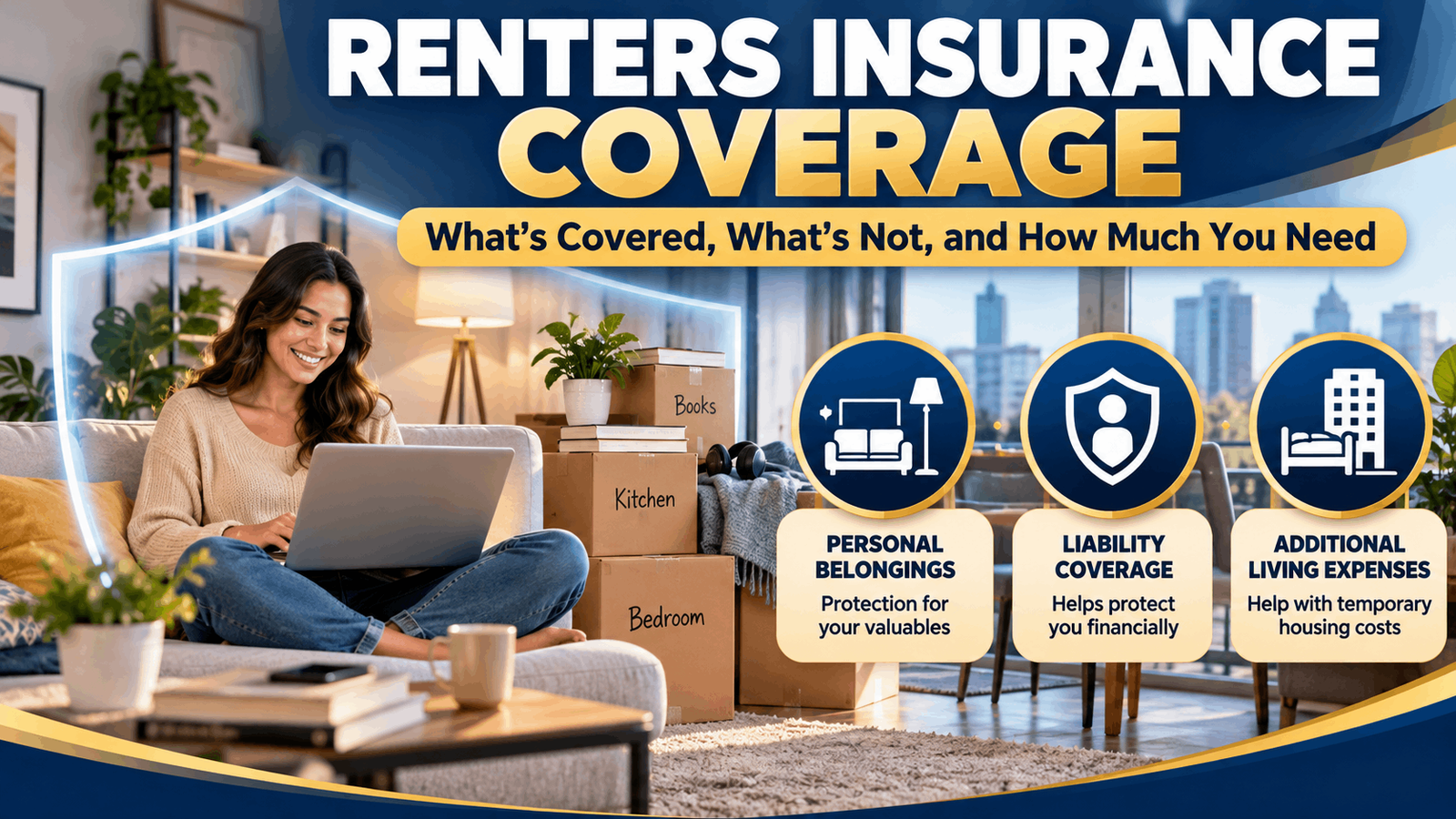
A typical policy may provide protection for personal property, personal liability, and additional living expenses when a covered event makes your rental temporarily uninhabitable.
However, not every type of damage is covered. Flooding, earthquakes, ordinary wear and tear, and certain high-value belongings may require additional protection or separate insurance.
This guide explains what renters insurance covers, what it excludes, how much coverage you may need, and how to compare policies in the United States.
What Is Renters Insurance Coverage?
Renters insurance coverage is a type of property insurance designed to protect people who rent their homes rather than own them.
It generally focuses on your personal belongings and certain financial responsibilities, instead of insuring the building itself.
For example, imagine a kitchen fire damages your rented apartment.
Your landlord’s property insurance may address covered damage to the building. Meanwhile, your renters policy may help replace damaged belongings and cover certain additional living expenses, depending on the cause of the fire and your policy terms.
According to the National Association of Insurance Commissioners (NAIC), renters should not assume their landlord’s insurance protects their personal possessions.
What Does Standard Renters Insurance Coverage Include?
Most renters policies provide several important types of protection.
| Coverage Type | What It Generally Helps Cover |
|---|---|
| Personal property | Belongings damaged or stolen because of covered events |
| Personal liability | Certain claims involving injuries to others or damage to their property |
| Additional living expenses | Eligible extra costs when a covered loss makes your home uninhabitable |
| Medical payments to others | Limited medical expenses for certain injuries involving guests or others |
These protections work together, but each has its own limits, conditions, and exclusions.
What Does Renters Insurance Coverage Actually Cover?
Understanding the major coverage categories can help you decide whether a policy provides enough protection for your situation.
1. Personal Property Coverage
Personal property coverage helps pay to repair or replace belongings damaged or stolen because of events covered by the policy.
These belongings may include:
- Furniture and mattresses
- Clothing and shoes
- Computers and televisions
- Phones and other electronics
- Kitchenware and small appliances
- Bedding and household items
- Books and personal possessions
- Certain bicycles and sporting equipment
For example, suppose a covered fire damages your couch, laptop, television, and clothing.
Your renters insurance may help reimburse the eligible loss, subject to the policy’s deductible, coverage limits, and settlement method.
Common covered events may include fire, smoke, theft, vandalism, and certain wind or water damage.
However, the exact list depends on your policy.
Important: Not all water damage is treated the same way. A sudden covered pipe leak may qualify for protection, while flooding or long-term leakage may be excluded.
2. Personal Liability Coverage
Personal liability insurance may help protect you financially if you are legally responsible for certain injuries or property damage involving someone else.
For example, imagine a guest slips in your apartment and suffers an injury because of a condition for which you are legally responsible.
Depending on the circumstances and policy terms, liability coverage may help with eligible medical-related damages, legal defense costs, or settlements.
Another example involves accidentally causing damage to someone else’s property.
However, liability insurance does not cover every accident, and intentional acts or certain activities may be excluded.
Coverage also has limits.
If a covered claim exceeds your liability limit, you may be personally responsible for the amount above that limit.
3. Additional Living Expenses Coverage
Additional living expenses, sometimes called loss-of-use coverage, can help pay eligible extra living costs if your rental becomes uninhabitable because of a covered event.
For example, suppose a covered fire makes your apartment unsafe to occupy for several weeks.
Your policy may help with eligible additional expenses such as:
- Temporary hotel accommodation
- Short-term rental housing
- Additional meal costs
- Certain extra transportation or household expenses
However, this protection generally covers eligible costs above your normal living expenses, not every expense you incur.
Coverage may also have dollar limits or time restrictions.
The NAIC’s guidance on additional living expenses explains why policyholders should understand these limits and keep receipts.
4. Medical Payments to Others
Some renters policies include limited medical payments coverage for certain injuries involving people who are not insured under the policy.
For example, a visitor may suffer a minor injury at your apartment.
Depending on the circumstances, medical payments coverage may help pay eligible medical bills, sometimes without requiring a legal determination of fault.
However, this coverage generally does not replace your own health insurance or cover every injury.
Review the specific policy provisions for details.
What Does Renters Insurance Not Cover?
Although renters insurance provides valuable protection, it does not cover every type of damage or financial loss.
Understanding exclusions is just as important as knowing what is included.
| Situation | Usually Covered by Standard Renters Insurance? |
|---|---|
| Theft of personal belongings | Yes, subject to policy terms |
| Fire damage to belongings | Yes, for covered fires |
| Certain sudden water damage | May be covered |
| Flood damage | Generally excluded |
| Earthquake damage | Generally excluded |
| Ordinary wear and tear | Excluded |
| Pest infestations | Generally excluded |
| Intentional damage | Generally excluded |
| Damage to your vehicle | Not covered as auto physical damage |
| Expensive jewelry above special limits | Additional coverage may be needed |
| A roommate’s belongings | Not automatically covered |
| Business equipment or activities | May have restrictions or exclusions |
Flood Damage
Standard renters policies generally exclude damage caused by flooding.
For example, if rising water enters your apartment during a major flood and destroys your belongings, a standard policy may not pay for the loss.
Separate flood insurance may be available for eligible renters.
If you live in an area with flood exposure, ask about contents-only flood protection.
Earthquake Damage
Damage caused by earthquakes is generally excluded from standard renters insurance.
Separate earthquake coverage or an endorsement may be available, depending on the insurer and state.
This can be particularly relevant for renters in earthquake-prone regions.
Wear and Tear or Poor Maintenance
Insurance is not intended to replace routine maintenance.
For example, an old mattress wearing out or an appliance gradually failing from age is generally not an insured loss.
Similarly, damage from long-term moisture or neglected maintenance may be excluded.
Pest Infestations
Damage caused by bedbugs, termites, rodents, or other pests is generally excluded from standard renters insurance.
Responsibility for pest treatment may depend on the lease, the cause of the problem, and applicable state or local law.
High-Value Personal Property
Some policies have special coverage limits for certain categories of belongings.
These may include:
- Jewelry
- Fine art
- Collectibles
- Valuable watches
- Certain electronics
- Specialized equipment
For example, a renter with expensive jewelry may need scheduled personal property coverage or another endorsement.
Ask the insurer about item-specific limits before assuming everything is fully protected.
Basic Renters Insurance Coverage vs. Additional Protection
Basic renters insurance coverage generally focuses on common personal property and liability risks.
However, the word basic is not a standardized policy designation. Insurers may offer different coverage levels, deductibles, endorsements, and limits.
A lower-cost policy may provide essential protection but still leave important gaps.
For example, a renter with modest belongings may need a different policy from someone who owns expensive electronics, jewelry, or specialized equipment.
When Additional Coverage May Be Worth Considering
You may want to explore extra protection if you:
- Own expensive jewelry or collectibles
- Have substantial personal property
- Live in an area exposed to floods or earthquakes
- Work from home with valuable business equipment
- Own certain pets that may affect liability eligibility
- Need higher personal liability limits
- Want replacement cost coverage instead of actual cash value
The goal is not necessarily to purchase every available endorsement.
Instead, identify the risks that matter most to your household.
How Much Renters Insurance Coverage Do I Need?
One of the most common questions renters ask is: How much renters insurance coverage do I need?
The answer depends on the value of your belongings, potential liability exposure, and how much financial risk you are comfortable handling.
A useful approach is to evaluate three major areas: personal property, liability protection, and temporary living expenses.
Step 1: Calculate the Value of Your Belongings
Start by creating a home inventory.
List the belongings you own and estimate what it would cost to replace them today.
Include furniture, electronics, clothing, kitchen items, and other possessions.
Here is a hypothetical example:
| Personal Property Category | Estimated Replacement Value |
|---|---|
| Furniture | $7,500 |
| Electronics | $6,000 |
| Clothing and shoes | $5,000 |
| Kitchen items and appliances | $3,000 |
| Bedding and linens | $2,000 |
| Bicycles and sporting equipment | $2,000 |
| Other personal belongings | $2,500 |
| Total | $28,000 |
In this example, the renter might consider approximately $30,000 in personal property coverage to provide some room for additional belongings.
However, this is only an illustration, not an average or universal recommendation.
Your actual needs may be significantly higher or lower.
Step 2: Evaluate Personal Liability Protection
Next, consider your potential financial exposure if someone is injured or their property is damaged and you are legally responsible.
For illustration, insurers may offer liability limits such as $100,000 or $300,000, although available options vary.
The appropriate amount depends on your assets, activities, household circumstances, and other factors.
A higher limit may provide more financial protection, but it can also affect the premium.
Step 3: Review Additional Living Expenses
Consider what would happen if you could not live in your apartment after a covered loss.
Would you need temporary housing?
Would staying in a hotel create additional food or transportation expenses?
Review the policy’s loss-of-use limits and any restrictions on how long benefits are available.
Step 4: Understand Your Deductible
A deductible is the amount you generally pay toward a covered property loss before the insurer pays the remaining eligible amount.
For example, suppose a covered property loss totals $4,000 and your deductible is $500.
If the entire loss is otherwise eligible, the insurer may pay $3,500.
However, deductibles do not necessarily apply in the same way to every coverage category.
A higher deductible may reduce premiums, but it also increases the amount you must pay after a covered loss.
Average Renters Insurance Coverage: Is There a Standard Amount?
Many people search for average renters insurance coverage to determine how much protection they should purchase.
However, there is no single coverage amount that is appropriate for every renter in the United States.
The value of belongings can vary significantly between a college student, a single professional, and a family renting a larger home.
Likewise, liability needs depend on individual circumstances.
What Is Typical Renters Insurance Coverage?
Typical renters insurance coverage includes personal property protection, personal liability, and often additional living expenses.
However, actual limits depend on the insurer and selected policy.
A renter with $10,000 worth of belongings may have different needs from someone whose possessions would cost $60,000 to replace.
Therefore, use a home inventory rather than relying on a generic average.
Does Standard Renters Insurance Coverage Include Everything?
No.
Standard renters insurance coverage may include several important protections, but deductibles, exclusions, and special limits still apply.
For example, expensive jewelry may have a lower theft limit than the policy’s overall personal property coverage amount.
Therefore, compare the policy’s individual limits rather than looking only at the total coverage figure.
Actual Cash Value vs. Replacement Cost Coverage
Another important decision involves how your insurer calculates payment for damaged or stolen belongings.
Two common settlement methods are actual cash value and replacement cost.
| Feature | Actual Cash Value | Replacement Cost |
|---|---|---|
| Depreciation | Generally deducted | Generally not deducted for eligible replacement |
| Claim payment | Based on depreciated value | Based on eligible cost of replacing the item |
| Premium | May be lower | May be higher |
| Main consideration | Lower premium but potentially smaller claim payment | More protection against replacement costs |
Actual Cash Value Example
Suppose you purchased a laptop several years ago.
A similar replacement now costs $1,500, but the laptop’s depreciated value is estimated at $600.
With actual cash value coverage, the eligible loss may be based on the lower depreciated value.
Replacement Cost Example
With replacement cost coverage, the policy may reimburse the eligible cost of purchasing a comparable replacement laptop.
However, deductibles, policy limits, and replacement requirements still apply.
Some insurers initially pay an actual cash value amount and reimburse the remaining eligible replacement cost after you replace the item and provide documentation.
The NAIC’s renters insurance guidance explains why this distinction matters when selecting coverage.
How Much Does Renters Insurance Cost?
The cost of renters insurance depends on your location, coverage limits, deductible, property characteristics, claims history, and insurer.
The NAIC’s 2024 consumer guidance cited average premiums of approximately $15–$30 per month. However, that is a historical general estimate, not a guaranteed current quote or a rate that applies to every renter.
Actual premiums may be higher or lower.
Factors That Affect Your Premium
| Factor | Potential Effect |
|---|---|
| Location | Local risks and insurance costs may affect pricing |
| Personal property limit | Higher limits may increase premiums |
| Liability limit | Additional protection may affect cost |
| Deductible | Higher deductibles may lower premiums |
| Claims history | Previous claims may influence pricing |
| Building safety features | Eligible alarms or security devices may qualify for discounts |
| Optional endorsements | Extra coverage may increase cost |
| Insurance company | Pricing varies between insurers |
To compare costs fairly, request quotes using the same coverage limits, deductible, and settlement method.
Does Renters Insurance Cover Belongings Outside Your Apartment?
In many cases, yes.
Certain renters policies provide protection for personal belongings even when they are temporarily outside your home.
For example, a laptop stolen from a hotel room or belongings stolen from a locked vehicle may qualify for coverage under some policies.
However, off-premises coverage can have separate limits or restrictions.
Also, renters insurance does not generally cover damage to the vehicle itself.
For vehicle-related protection, explore auto insurance information from HHAS Insurance.
Is Renters Insurance Required by Law?
Renters insurance is generally not legally required for every tenant in the United States.
However, a landlord or property management company may require coverage as part of the rental agreement.
For example, your lease may specify a minimum personal liability limit or require proof of insurance before move-in.
Requirements vary by lease and jurisdiction.
Therefore, review your rental agreement and applicable local rules.
Even when coverage is not required, renters insurance may help protect you from unexpected financial losses.
Real-Life Examples of Renters Insurance Coverage
The following examples illustrate how different situations may be handled.
| Situation | Possible Coverage Outcome |
|---|---|
| A covered fire destroys your furniture | Personal property coverage may apply |
| A thief steals your television | Theft coverage may apply |
| A covered fire forces you into a hotel | Additional living expenses may apply |
| A guest is injured and you are legally responsible | Liability coverage may apply |
| Floodwater damages your belongings | Generally excluded without separate flood protection |
| An earthquake damages your possessions | Generally excluded without additional earthquake coverage |
| Your laptop stops working because of age | Generally not covered |
| Expensive jewelry is stolen | Coverage may be subject to special limits |
These are general examples. Actual claims depend on the cause of loss, policy language, limits, exclusions, and applicable law.
How to Find the Best Renters Insurance Coverage
The best renters insurance coverage is not necessarily the policy with the lowest monthly premium.
Instead, it is coverage that matches your belongings, financial responsibilities, and potential risks.
Compare Coverage Limits
Start by reviewing how much personal property and liability protection each policy provides.
A low-cost policy may be insufficient if the limits do not match your needs.
Review Exclusions Carefully
Ask about flood damage, earthquakes, water backup, valuable items, and any restrictions relevant to your rental property.
Understanding exclusions before purchasing can help prevent surprises later.
Choose the Right Settlement Method
Compare actual cash value and replacement cost options.
Although replacement cost coverage may be more expensive, it can provide a more useful settlement when eligible belongings must be replaced.
Look for Available Discounts
Depending on the insurer, discounts may be available for:
- Bundling eligible insurance policies
- Installing qualifying security devices
- Having certain fire safety equipment
- Maintaining a claims-free history
- Paying premiums annually
Discount availability and eligibility vary.
Review the Insurance Company’s Service
Consider claims procedures, customer support, financial strength, and policy terms.
A policy’s usefulness depends on more than its advertised price.
How HHAS Insurance Can Help You Explore Property Insurance
Understanding renters insurance coverage is an important part of protecting your personal belongings and finances.
However, choosing a policy also requires evaluating coverage limits, deductibles, exclusions, and available insurance options.
HHAS Insurance Services Inc. provides insurance information and services for consumers and businesses.
Its home insurance information page discusses property insurance coverage, including the HO-4 renters insurance form.
If you have questions about renters insurance or related property protection, you can contact the agency to ask about available options and eligibility in your area.
Have questions about protecting your belongings?
Contact HHAS Insurance Services Inc. to discuss your insurance needs and ask about available coverage options.
Policy availability and pricing depend on the insurer, state, and underwriting requirements.
Frequently Asked Questions About Renters Insurance
What Does Renters Insurance Usually Cover?
Renters insurance generally covers eligible personal property losses, certain personal liability claims, and additional living expenses when a covered event makes your rental uninhabitable.
Specific benefits depend on the policy.
How Much Renters Insurance Coverage Do I Need for an Apartment?
Start by calculating the replacement value of your belongings.
Then evaluate personal liability limits and additional living expenses protection.
Your needs depend on your possessions, financial circumstances, and lease requirements.
Does Renters Insurance Cover Theft?
Many renters policies cover theft of eligible personal belongings.
However, deductibles, special item limits, and exclusions may apply.
Does Renters Insurance Cover Water Damage?
Some sudden and accidental water damage may be covered.
However, flooding, gradual leaks, and certain water-related events are generally excluded or restricted.
Does Renters Insurance Cover Flooding?
Standard renters insurance generally excludes flood damage.
Separate flood insurance may be available to protect eligible personal belongings.
Does Renters Insurance Cover My Roommate?
A roommate’s belongings are not automatically covered under your policy.
Coverage depends on who qualifies as an insured and the policy’s specific provisions.
Roommates should confirm their coverage arrangements rather than assume they are protected.
Does Renters Insurance Cover Pets?
Personal liability coverage may apply to certain pet-related injuries or property damage.
However, insurers may impose animal-related exclusions, eligibility restrictions, or other conditions.
Does Renters Insurance Cover a Stolen Laptop?
A stolen laptop may be covered under personal property protection.
However, the claim depends on the circumstances, deductible, coverage limits, and any applicable exclusions.
Does Renters Insurance Cover Mold?
Mold coverage is often limited or excluded.
In some cases, mold resulting from a covered event may receive limited protection, depending on the policy.
Review the contract carefully.
Does Renters Insurance Cover My Car?
Renters insurance generally does not pay for physical damage to your vehicle.
However, eligible personal belongings stolen from a vehicle may be covered under certain renters policies.
Can a Landlord Require Renters Insurance?
Yes. A landlord may require renters insurance as a condition of the lease, subject to applicable laws.
Review the rental agreement for minimum coverage requirements.
Is Renters Insurance Worth It?
Renters insurance may be valuable if replacing your belongings, paying for temporary housing, or handling a covered liability claim would create financial hardship.
The decision should reflect your personal risk exposure and budget.
Final Thoughts: Choosing the Right Renters Insurance Coverage
Understanding renters insurance coverage helps you make informed decisions about protecting your belongings and financial security.
A typical policy may protect personal property, provide liability coverage, and help with additional living expenses after a covered loss.
However, exclusions and coverage limits matter.
Flooding, earthquakes, ordinary wear and tear, and certain high-value belongings may require separate protection or additional endorsements.
Before purchasing, create a home inventory, evaluate your liability needs, review deductibles, and compare policy terms.
Most importantly, choose coverage based on your actual needs rather than relying only on the lowest premium.
Protect your belongings and make informed insurance decisions.
Visit HHAS Insurance Services Inc. or contact the agency to learn more about available insurance options.