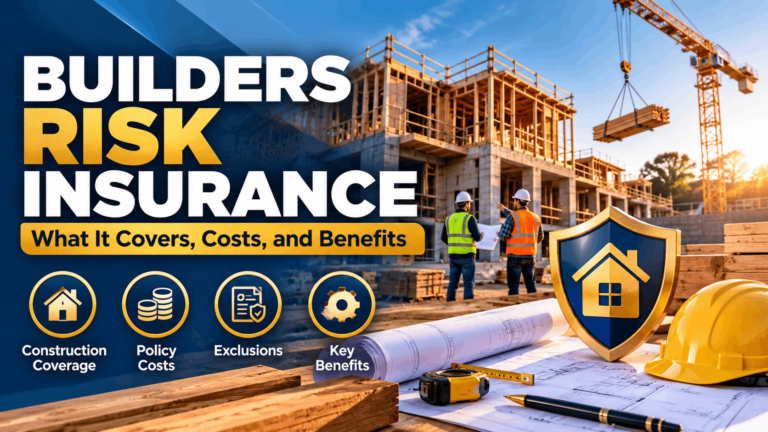
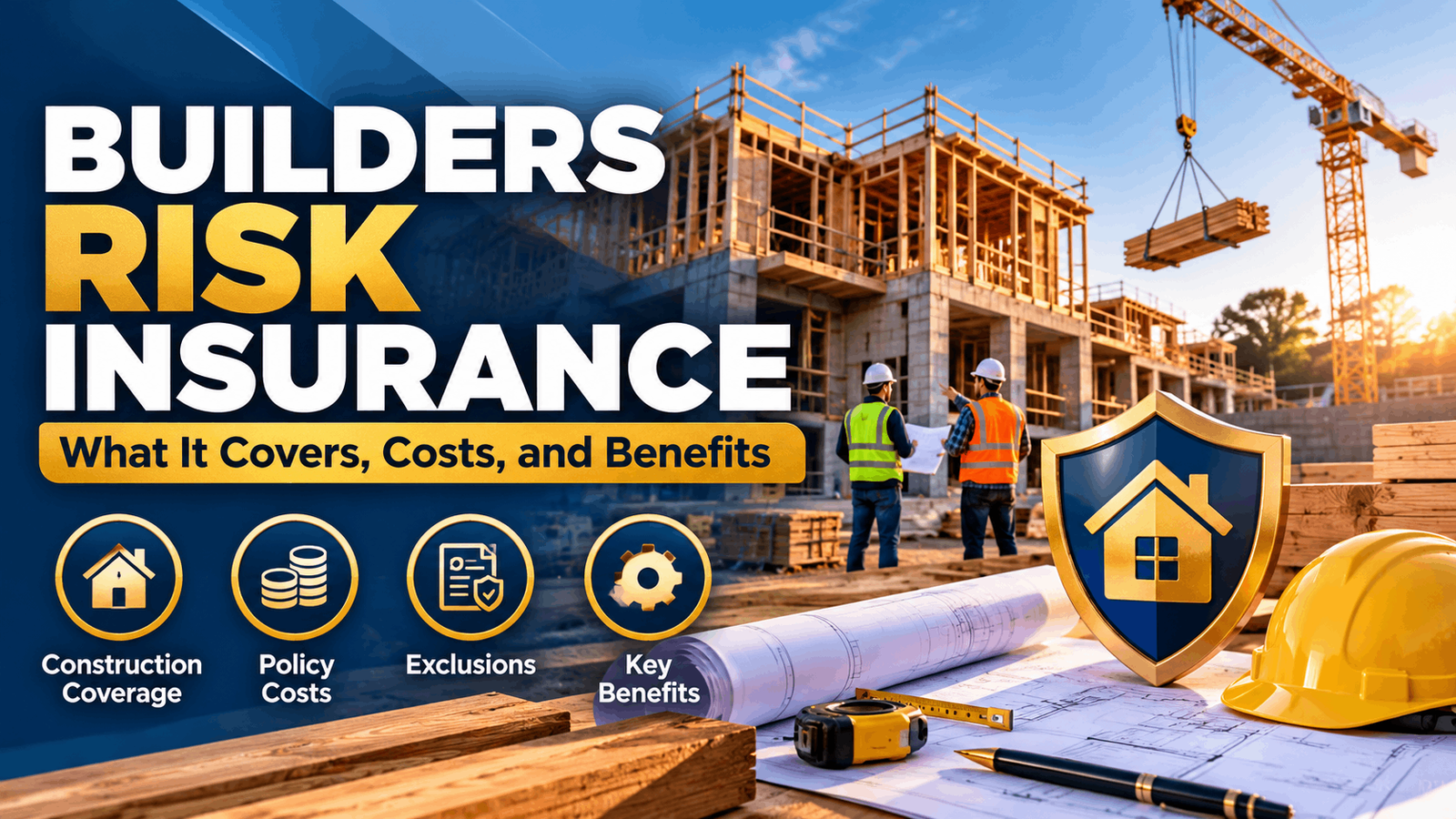
Builders risk insurance helps protect buildings and construction materials from certain unexpected losses while a construction project is underway. Whether you are building a new home, renovating a commercial property, or managing a major remodeling project, understanding this coverage can help you avoid expensive financial setbacks.
Construction projects involve significant investments in materials, labor, and equipment. However, a fire, theft, severe storm, or other covered event can damage unfinished work before the building is ready for use.
For example, imagine a contractor is halfway through constructing a new commercial building when a fire damages the framing and installed materials. Without appropriate construction property insurance, the financial consequences could be substantial.
Fortunately, a properly selected builders risk policy may help cover eligible repair or replacement costs.
In this guide, we’ll explain what builders risk insurance covers, common exclusions, policy costs, major benefits, who needs coverage, and how to choose the right protection for a construction project.
What Is Builders Risk Insurance?
Builders risk insurance is a type of property insurance designed to protect buildings and certain materials during construction, renovation, or remodeling.
It is also commonly called course of construction insurance.
Unlike standard property insurance, which primarily addresses completed buildings, builders risk coverage focuses on property exposed to loss while construction work is taking place.
For example, a newly constructed home may not yet qualify for ordinary homeowners insurance in the same way as a completed, occupied residence.
Similarly, a commercial building undergoing major renovations may require specialized protection for unfinished work and materials.
The International Risk Management Institute (IRMI) explains that builders risk policies are designed for property in the course of construction. Coverage can extend beyond the jobsite to certain materials in storage or transit, depending on the policy.
How Builders Risk Coverage Works
A builders risk insurance policy typically protects eligible property against direct physical loss or damage caused by covered events.
For instance, suppose a covered windstorm damages the unfinished roof of a building.
The policy may help pay for eligible repairs, subject to the deductible, coverage limits, exclusions, and other terms.
However, builders risk insurance does not automatically cover every construction-related problem.
Poor workmanship, employee injuries, contractual disputes, and ordinary project delays generally require different considerations or insurance arrangements.
Therefore, understanding the exact scope of coverage is essential before construction begins.
What Does Builders Risk Insurance Cover?
One of the most common questions is: What does builders risk insurance cover?
Generally, coverage focuses on the structure being built and eligible materials, supplies, and fixtures associated with the project.
However, covered property and covered causes of loss vary by insurer.
Buildings Under Construction
The primary purpose of builders risk insurance is to protect the insured construction project.
Eligible property may include:
- New residential buildings under construction.
- Commercial buildings being developed.
- Structures undergoing qualifying renovations.
- Building additions and major remodeling projects.
- Permanent fixtures and installed building components.
For example, if a covered fire damages partially completed walls, roofing, and flooring, the policy may help pay for eligible repair or replacement costs.
Nevertheless, coverage for existing structures during renovations must be reviewed separately.
Construction Materials and Supplies
Many policies cover materials intended to become part of the insured building.
Examples may include lumber, drywall, roofing materials, windows, doors, electrical components, and plumbing supplies.
Some policies also extend coverage to eligible materials temporarily stored away from the jobsite or transported to the project.
However, off-site storage and transit protection may have separate limits or conditions.
Before purchasing a policy, confirm where materials are insured and whether supplier-owned property is included.
Fire, Theft, Vandalism, and Certain Weather Events
Depending on the insurance contract, builders risk coverage may protect against events such as:
- Fire and lightning.
- Theft of covered construction materials.
- Vandalism.
- Certain wind and hail damage.
- Explosion.
- Certain accidental physical damage.
- Specified collapse-related losses.
For example, if thieves remove installed copper wiring from a covered construction project, the loss may qualify for payment under the policy’s theft provisions.
However, security conditions, exclusions, and deductibles can affect the outcome.
Travelers’ builders risk insurance overview describes the types of construction property and physical losses that may be eligible for coverage.
Optional Protection for Construction Delays
A major insured loss can delay project completion.
Consequently, owners may face additional expenses beyond the cost of repairing damaged property.
Certain builders risk policies offer optional coverage for qualifying soft costs or delayed completion losses.
Depending on the endorsement, eligible expenses may include additional construction loan interest, certain professional fees, extended insurance expenses, or other specified costs caused by a covered delay.
However, these benefits are not automatically included in every policy.
The IRMI guide to delayed completion coverage explains how specialized insurance provisions may address certain financial consequences of delayed construction.
What Does a Builders Risk Insurance Policy Not Cover?
Although builders risk insurance provides important protection, it is not a substitute for every type of construction insurance.
Common exclusions or limitations may involve the following situations.
Faulty workmanship or defective materials: The cost of correcting defective work is often excluded. However, some policies may cover certain resulting physical damage, depending on their wording.
Employee injuries: Builders risk insurance is property coverage, not workers’ compensation insurance.
Third-party liability claims: Injuries to visitors or damage to another person’s property may require general liability coverage.
Contractor tools and equipment: Portable tools, machinery, and equipment that will not become part of the finished structure may require separate insurance.
Flood and earthquake damage: These events may be excluded unless specific coverage is purchased.
Normal wear and tear: Gradual deterioration and ordinary aging generally are not covered construction losses.
Intentional damage or dishonest acts: Certain intentional or dishonest conduct may be excluded.
Uncovered project delays: Delays caused by labor shortages, permitting problems, or other events without covered physical damage are generally not insured under standard builders risk property coverage.
Because exclusions differ, review the complete policy rather than relying on a general description.
Builders Risk Insurance for Homeowners and Contractors
Builders risk insurance can be relevant to several parties involved in construction.
However, the need for coverage depends on the project, existing insurance, and contractual responsibilities.
Builders Risk Insurance for Homeowners
Homeowners sometimes assume their existing homeowners insurance automatically covers major renovations or new construction.
That assumption can create coverage gaps.
For example, someone building a custom home may need protection for the unfinished structure and materials before the residence is completed.
Similarly, a homeowner planning an extensive addition or major structural renovation should discuss the project with their current insurer.
Minor home improvements may be handled differently from major construction work.
Therefore, homeowners should ask whether their existing policy provides adequate protection or whether separate builders risk coverage is necessary.
For additional information about residential property protection, explore HHAS Insurance’s home insurance services.
General Contractors and Construction Companies
General contractors frequently manage construction projects involving multiple subcontractors, suppliers, and expensive materials.
A covered property loss can disrupt schedules and create additional financial obligations.
Builders risk coverage may help protect the project’s physical property while construction continues.
However, contractors should also review their business insurance needs, including liability and other relevant coverage.
Property Developers and Commercial Building Owners
Commercial developers may have substantial financial investments tied to construction schedules.
For example, a developer building a retail center may face additional financing expenses if covered damage delays completion.
Therefore, appropriate builders risk coverage, together with any necessary delayed completion protection, can be an important part of project risk management.
Builders Risk Insurance Cost: What Determines the Price?
Builders risk insurance cost depends on the characteristics of the construction project and the protection selected.
There is no single premium that applies to every project in the United States.
A small residential renovation, for example, may have very different insurance requirements from a large commercial development.
Total Construction Value
The value of the insured construction project is a major consideration.
Insurers generally evaluate the estimated completed value of the insured work, including relevant materials and labor costs.
However, the appropriate insured value depends on the policy form and project details.
Land value is generally not included in the insured construction property value.
For example, a project involving $300,000 in construction costs may require a different amount of coverage than a project involving $2 million in construction costs.
Type of Construction
The materials and methods used to construct a building can affect insurance pricing.
For example, a wood-frame residential project may present different fire exposures than a building constructed primarily with steel and concrete.
Additionally, renovation projects may involve risks related to existing structures.
Therefore, insurers often consider the type of construction when evaluating a project.
Location and Weather Exposure
Construction projects face different risks depending on their geographic location.
For example, coastal projects may have greater hurricane exposure, while other areas may experience significant hail, wildfire, or flood risks.
As a result, location can influence premiums, deductibles, and coverage availability.
Construction Duration
A project scheduled to take several months may present different exposure than one expected to continue for several years.
Longer construction periods can mean more time during which insured property is exposed to potential losses.
However, the relationship between duration and premium depends on the insurer and project.
Deductibles and Additional Coverage
A higher deductible may reduce the premium, but it also increases the amount the insured must absorb after a covered loss.
Meanwhile, optional protections such as flood coverage, earthquake coverage, off-site storage, or delayed completion insurance may affect the total price.
Therefore, compare quotes based on both cost and coverage.
Example: How Builders Risk Insurance May Help After a Loss
Consider a hypothetical commercial construction project with an insured completed value of $750,000.
During construction, thieves steal covered materials worth $40,000.
Assume the policy covers the theft, the materials are included in the insured property, and a $2,500 deductible applies.
| Claim calculation | Amount |
|---|---|
| Eligible covered material loss | $40,000 |
| Applicable deductible | $2,500 |
| Illustrative insurance payment | $37,500 |
| Insured’s responsibility | $2,500 |
In this simplified example, the insurer may pay $37,500 toward the eligible loss.
However, actual claim payments depend on valuation provisions, limits, exclusions, and other policy conditions.
Without appropriate coverage, the project owner or contractor might have to absorb the full financial impact.
This example illustrates the value of identifying construction property risks before work begins.
Key Benefits of Builders Risk Insurance
Builders risk coverage offers several potential advantages for construction projects.
Financial Protection Against Covered Property Losses
Construction materials and partially completed structures represent significant financial investments.
If a covered event damages insured property, builders risk insurance may help fund eligible repairs or replacement.
Consequently, the policy can reduce the amount of unexpected property loss expenses that must be paid directly by the insured.
Protection for Materials Before Installation
Construction materials may be purchased and delivered well before installation.
Depending on the policy, eligible materials may be protected while stored at the jobsite, in approved off-site locations, or in transit.
This can be particularly useful when projects require expensive materials ordered in advance.
Support for Project Continuity
A covered loss can interrupt construction and create scheduling difficulties.
Although insurance cannot prevent every delay, appropriate property coverage may provide funds to repair damage and resume work.
Furthermore, optional delayed completion coverage may address certain additional expenses resulting from covered physical damage.
Meeting Contractual and Financing Requirements
Some construction contracts and lenders require builders risk insurance.
For example, a lender financing a construction project may require evidence of suitable property coverage.
Similarly, an owner-contractor agreement may specify which party must purchase the policy.
Therefore, having appropriate insurance can help satisfy applicable project requirements.
Protection for Multiple Project Interests
A construction project may involve an owner, general contractor, subcontractors, and other parties with financial interests.
Depending on the contract and policy, more than one party may need to be identified as an insured.
However, being involved in the project does not automatically make someone an insured under the policy.
Review named insureds, additional insured provisions, and each party’s insurable interest carefully.
Who Pays for Builders Risk Insurance?
Who pays for builders risk insurance depends primarily on the construction contract and the parties’ agreement.
There is no universal rule requiring the homeowner, contractor, or developer to pay in every situation.
For example, a homeowner building a custom residence may arrange and pay for the coverage directly.
In another project, the general contractor may purchase the policy and include its cost within the construction contract.
Commercial developers may also obtain coverage as part of their project financing arrangements.
However, the party paying the premium is not necessarily the only party that needs protection.
The construction agreement should clearly address:
- Who is responsible for obtaining coverage.
- Who pays the insurance premium.
- Which parties are insured.
- Who is responsible for the deductible.
- What limits and additional coverages are required.
- When coverage must begin and end.
The IRMI discussion of builders risk insurance responsibilities explains why owners and contractors should coordinate insurance obligations before construction starts.
How Long Does Builders Risk Insurance Last?
Builders risk insurance is generally intended to protect property during the construction period.
Unlike ordinary annual property insurance, the coverage period may be tied to a specific project.
For example, a policy may be issued for an anticipated six-month, twelve-month, or longer construction period.
However, coverage does not necessarily remain active until the policy’s stated expiration date in every circumstance.
Depending on the contract, protection may end when certain events occur, such as:
- Construction is completed.
- The building is accepted by the owner.
- The property becomes occupied or put to its intended use.
- The insured’s interest in the property ends.
- The policy expires or is canceled.
Some policies permit limited occupancy or offer extensions, subject to approval.
Therefore, confirm the termination conditions before moving into a new building or opening a completed commercial property.
If construction is delayed, contact the insurer before the coverage period ends.
How to Get a Builders Risk Insurance Quote
Obtaining a builders risk insurance quote generally requires information about the project, its location, construction methods, and estimated value.
Preparing accurate details can help insurers evaluate the exposure.
Step 1: Identify the Project Type
Determine whether the work involves new residential construction, commercial development, renovation, or a major addition.
Additionally, describe any existing structures that may be affected.
Step 2: Estimate the Insured Construction Value
Prepare the project’s construction budget, including eligible materials, labor, and other costs relevant to the insured value.
However, do not assume the property purchase price is the correct insurance limit.
Ask the insurance professional how the policy defines completed value.
Step 3: Provide the Construction Timeline
Include the expected start date and completion date.
If the project has already begun, disclose its current stage.
Some insurers may restrict or decline coverage for projects that are already underway.
Step 4: Describe Construction Materials and Security
Insurers may ask about the building’s construction type, fire protection, site security, and storage arrangements.
For example, a fenced construction site with controlled access may present different theft exposures from an unsecured location.
Step 5: Review Coverage and Exclusions
Compare quotes carefully.
Look beyond the premium and review the insured property definition, covered events, deductibles, limits, optional protections, and policy termination provisions.
In particular, confirm whether existing structures, off-site materials, and flood or earthquake exposures require additional coverage.
Builders Risk Insurance vs. Other Construction Insurance
Builders risk insurance protects different exposures from general liability, workers’ compensation, and other business policies.
Understanding these differences can help prevent important gaps.
| Insurance Type | Primary Purpose |
|---|---|
| Builders Risk Insurance | Covers eligible physical loss or damage to insured construction property |
| General Liability Insurance | Addresses certain third-party bodily injury and property damage claims |
| Workers’ Compensation Insurance | Provides benefits for qualifying employee work-related injuries or illnesses |
| Contractors Equipment Insurance | Protects eligible contractor-owned or insured tools and equipment |
| Professional Liability Insurance | Addresses certain professional errors, omissions, or negligence claims |
For example, builders risk insurance may respond to covered theft of construction materials.
However, if a visitor is injured at the jobsite, the resulting liability claim would generally fall outside the builders risk policy’s primary purpose.
Therefore, contractors should evaluate their overall business insurance coverage rather than relying on one policy.
Common Mistakes When Buying Builders Risk Coverage
Several preventable mistakes can leave construction projects exposed to unexpected costs.
Starting construction before coverage begins: Some insurers may not provide retroactive protection for work already completed or losses that occurred before the effective date.
Underestimating the completed project value: Inadequate limits may leave the insured responsible for part of a major loss.
Ignoring off-site materials: Materials stored at another location may need separate coverage terms.
Assuming flood and earthquake damage are included: These events may require specific endorsements or separate policies.
Overlooking existing structures: Renovation policies may cover only the new work unless the existing building is specifically insured.
Failing to coordinate insured parties: Owners, contractors, and subcontractors should understand whose interests are protected.
Forgetting the policy’s termination conditions: Occupancy, completion, or acceptance may affect coverage.
Fortunately, discussing these issues before construction begins can reduce uncertainty.
Frequently Asked Questions
Is Builders Risk Insurance Required by Law?
Builders risk insurance is not universally required by law for every construction project in the United States.
However, lenders, project owners, and construction contracts may require it.
Therefore, check the applicable contract, financing documents, and local requirements before beginning work.
Does Builders Risk Insurance Cover Existing Buildings?
Some policies can cover existing structures during renovations, but this protection is not automatic.
For example, an endorsement may be needed to insure an existing building undergoing substantial remodeling.
Additionally, the insurer may apply different valuation terms to the existing structure and new construction work.
Can Homeowners Purchase Builders Risk Insurance?
Yes, homeowners may be able to obtain builders risk coverage for eligible new construction or major renovation projects.
However, eligibility depends on the insurer, property, and construction arrangements.
Before purchasing a policy, review the project with your existing homeowners insurance provider.
Does Builders Risk Insurance Cover Contractor Equipment?
Not necessarily.
Builders risk coverage generally focuses on the structure and eligible materials intended for the project.
Portable tools, heavy machinery, and equipment used to perform construction may require separate contractors equipment insurance.
Therefore, confirm exactly which equipment is included.
Does Builders Risk Insurance Cover Rain Damage?
Coverage depends on the policy and the circumstances.
For example, certain rain-related damage may be covered under an applicable policy, while damage resulting from inadequate temporary protection or excluded causes may not be.
Additionally, flood damage is commonly treated differently from ordinary rain-related losses.
Review the specific water damage exclusions and conditions.
Is Builders Risk Insurance the Same as Homeowners Insurance?
No.
Builders risk insurance is designed for property during construction, while homeowners insurance generally protects an eligible residential property and its associated exposures.
Although there may be some overlap during renovations, the policies serve different purposes.
Can Builders Risk Insurance Cover Construction Delays?
Standard builders risk insurance primarily addresses eligible physical property damage.
However, optional soft costs or delayed completion coverage may help with certain financial losses resulting from a covered construction delay.
Ordinary scheduling problems and delays unrelated to covered physical damage are generally not covered.
Can You Buy Builders Risk Insurance After Construction Starts?
Some insurers may consider projects that are already underway, but eligibility and terms can be more restrictive.
Additionally, losses that occurred before the policy became effective would not be covered retroactively.
Therefore, arranging protection before construction begins is generally preferable.
Review Your Construction Insurance Needs With HHAS Insurance
Construction projects involve financial risks that should be evaluated before work begins.
Whether you are a homeowner planning a major renovation, a contractor managing a building project, or a developer preparing new construction, understanding your insurance responsibilities is an important part of protecting your investment.
HHAS Insurance Services Inc. provides information and assistance with business insurance and home insurance.
If you are preparing for a construction project, consider discussing the property coverage you need, the parties who should be insured, and the policy terms required by your contract or lender.
You can request a business insurance quote or contact HHAS Insurance to discuss your situation.
The availability of builders risk insurance and specific coverage options should be confirmed directly with the agency and applicable insurance carriers.
Final Thoughts
Builders risk insurance can provide important financial protection for buildings and eligible materials while construction is underway.
Its potential benefits include protection against certain fires, theft, vandalism, and weather-related losses, along with optional coverage for specified additional construction expenses.
However, policy costs, exclusions, deductibles, and coverage periods vary depending on the insurer and project.
Before construction begins, identify the parties responsible for obtaining insurance, calculate the appropriate insured value, review potential risks, and compare available policy terms.
For help reviewing your broader insurance needs, explore HHAS Insurance’s business insurance services or contact the agency to discuss your upcoming project.