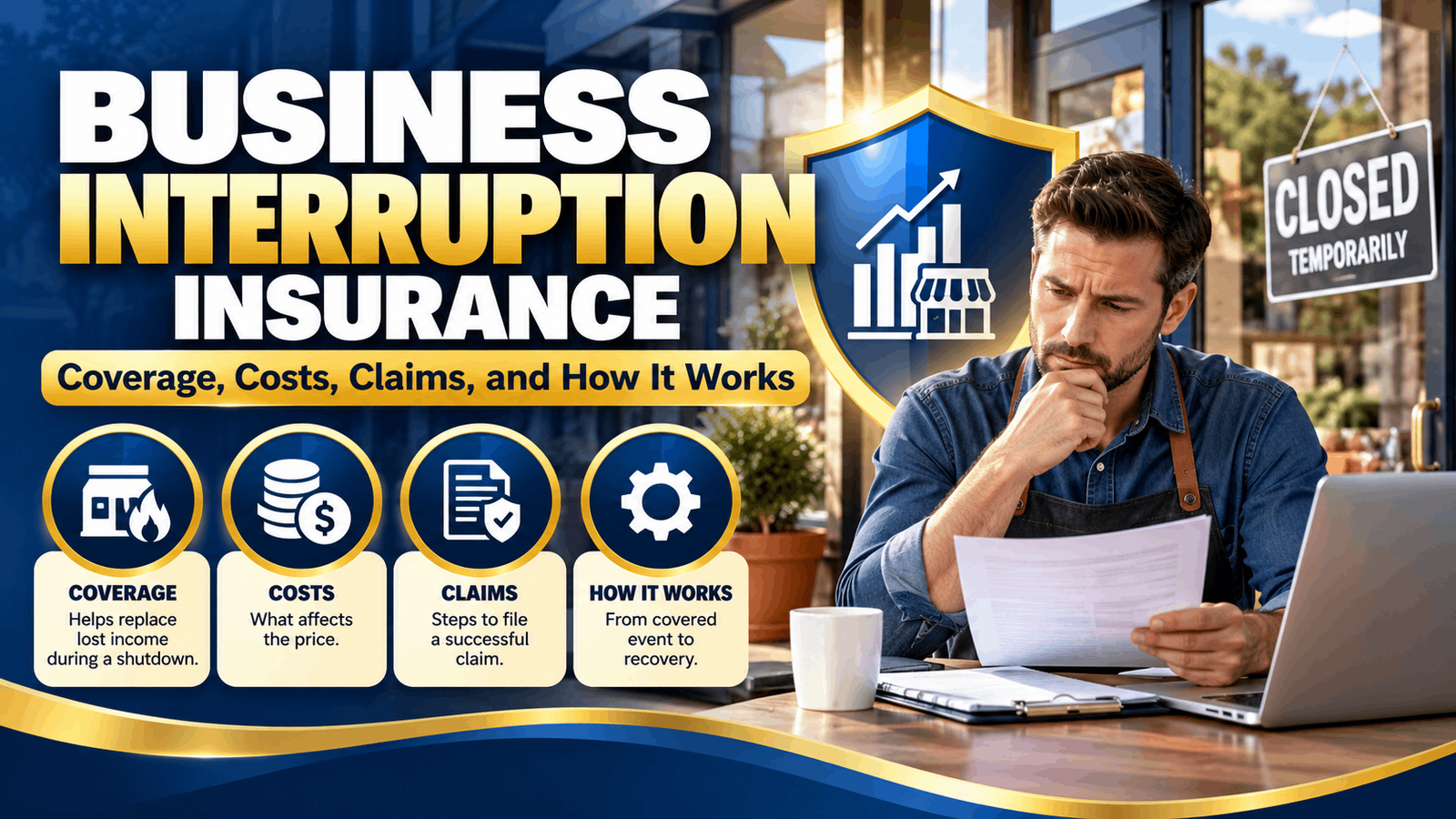
Business interruption insurance can help a company keep paying essential bills when a covered event forces operations to stop. A fire that damages a restaurant kitchen, for example, may interrupt sales long after the flames are extinguished. Although property insurance can help repair the building and equipment, those repairs do not replace the income the business would have earned while closed.
That is where business income protection may help. However, a temporary shutdown does not automatically qualify for payment. The cause of the interruption, the policy’s waiting period, and the financial records supporting the loss all matter.
For U.S. business owners, understanding these details before a disaster can make recovery less uncertain. This guide explains what the coverage pays, how it works, what it excludes, how pricing is determined, and how to prepare a claim.
What Is Business Interruption Insurance?
Business interruption insurance, also called business income insurance, helps replace eligible income lost when operations are suspended because of a covered event. In a typical commercial property or businessowners policy (BOP), that event must involve direct physical loss or damage from a covered cause, such as a fire.
Rather than paying to rebuild the damaged property, the coverage addresses the financial consequences of being unable to operate normally. For example, it may account for lost net income and certain ongoing expenses during the covered restoration period.
The National Association of Insurance Commissioners (NAIC) explains that business income protection is commonly included in a BOP alongside commercial property and liability coverage. Still, the precise trigger, payment terms, and exclusions depend on the policy.
How Business Interruption Insurance Works
Most standard business income claims begin with a covered property loss. First, the insurer determines whether the damage falls within the policy’s covered causes of loss. Next, it evaluates whether the damage caused a necessary suspension or reduction of operations. Finally, the claim calculation considers the income the company would likely have earned and eligible expenses during the covered period.
Example: A Fire Temporarily Closes a Bakery
Imagine a bakery must close for several weeks after a covered kitchen fire. While repairs are underway, it loses customer sales but continues paying rent and certain employees. To serve existing customers, the owner also rents a temporary kitchen.
Here is a simplified, hypothetical estimate for an eligible period:
| Financial impact | Illustrative amount |
|---|---|
| Net income the bakery would have earned | $8,000 |
| Eligible continuing operating expenses | $14,000 |
| Eligible additional temporary-kitchen expenses | $3,000 |
| Potential amount before policy adjustments | $25,000 |
The $25,000 is not a guaranteed claim payment. Actual reimbursement depends on the policy’s loss calculation, coverage limits, waiting period, extra expense terms, and supporting documentation. In addition, the insurer will consider any revenue earned during the interruption and expenses the business no longer incurred.
Understanding the Period of Restoration
Business income coverage generally applies during a defined period of restoration. This is the time reasonably required to repair, rebuild, or replace damaged property and resume operations, subject to policy wording. Consequently, a business cannot assume the insurer will pay until sales return to their previous level.
Some policies also have a waiting period before business income payments begin. Although a waiting period of roughly 48 to 72 hours is common in certain forms, your contract may be different. Extended business income coverage, when included, may provide limited protection after operations resume while revenue recovers.
What Does Business Interruption Insurance Cover?
The central purpose is to help a company manage eligible financial losses during a covered shutdown. However, covered amounts are not the same as all lost sales, and payments are subject to policy limits and conditions.
Lost Net Income and Continuing Expenses
Business interruption insurance coverage may account for the net income the company would have earned if the loss had not occurred. It can also include qualifying normal operating expenses that continue during the interruption, depending on the policy.
Examples may include rent, certain payroll costs, taxes, and ongoing loan obligations. However, the insurer generally considers actual financial records, expected sales trends, and expenses saved during the closure. As a result, a business’s gross revenue alone is not an accurate measure of its claim.
Extra Expense Coverage
Extra expense coverage may reimburse necessary additional costs incurred to avoid or reduce a shutdown. For instance, a company might lease temporary premises, rent equipment, or pay for expedited shipping to continue serving customers.
These costs must meet the applicable policy conditions. Therefore, owners should obtain approval when required and keep receipts for every additional expense.
Business Income vs. Property Damage
Commercial property insurance generally addresses covered damage to the building, equipment, or inventory. By contrast, business income coverage addresses the eligible financial interruption caused by that damage. Both can be important, but neither automatically substitutes for the other.
Business Interruption Insurance Exclusions to Review
A business can lose income for many reasons, yet standard coverage does not apply to every disruption. In particular, the requirement for covered physical loss or damage is a major distinction.
Common limitations include:
- Uncovered causes of property damage: Flood and earthquake losses are often excluded unless appropriate coverage is arranged.
- Pandemics and disease-related closures: Standard forms commonly exclude virus-related losses or lack the physical-damage trigger; specialized terms may differ.
- Ordinary utility outages: A power or water interruption without the required covered damage may not qualify unless an appropriate utility-services endorsement applies.
- Routine maintenance or voluntary closures: Planned repairs and business decisions generally do not trigger standard business income protection.
- Losses beyond the covered period: A prolonged decline in demand after the applicable restoration period may not be covered without an extension.
- Undocumented or speculative income: Insurers need reliable financial evidence to calculate eligible lost income.
Cyberattacks are another important example. A cyber incident that interrupts systems may require dedicated cyber business interruption coverage rather than a standard property-based form. Consequently, review the actual exclusions and endorsements instead of assuming that every interruption is insured.
Additional Types of Business Interruption Coverage
Standard protection often focuses on damage at the insured premises. Nevertheless, optional extensions may address certain losses that originate elsewhere.
Contingent Business Interruption Insurance
Contingent business interruption insurance can address eligible income losses caused by covered damage at a supplier’s, customer’s, or other specified dependent property’s location. For example, a manufacturer might lose production when a critical supplier’s facility suffers a covered fire.
However, ordinary shipping delays, supplier bankruptcy, or general shortages do not automatically qualify. The dependent property’s role, cause of damage, location restrictions, and contract wording all matter.
Civil Authority Coverage
A civil authority provision may apply when a government order prohibits access to the insured premises because of covered physical damage to nearby property. For instance, officials might close a commercial block after a major fire damages an adjacent building.
Still, the order, geographic restrictions, waiting period, and duration must satisfy the policy. A general government restriction without the required damage may not trigger coverage.
Utility Services and Extended Business Income
A utility-services endorsement may address specified income losses following covered damage to off-premises power, water, or communication infrastructure. Separately, extended business income may help during a limited recovery period after the property is restored.
These are not universal benefits. Therefore, ask which endorsements are included and what events, waiting periods, and sublimits apply.
Business Interruption Insurance Cost: What Affects the Price?
Business interruption insurance cost varies by company, location, insurer, and the way the coverage is packaged. Often, it is part of a BOP or commercial property policy rather than a separately priced product.
Insurers may evaluate several factors:
| Pricing factor | Why it matters |
|---|---|
| Industry and business operations | Some businesses are more vulnerable to extended shutdowns |
| Revenue and continuing expenses | These help determine the potential financial exposure |
| Property location and hazards | Fire, storm, and other covered-loss risks vary by location |
| Coverage limits and extensions | Higher limits and broader options may affect premiums |
| Restoration needs | Specialized machinery or difficult repairs may lengthen recovery |
| Claims history and risk controls | Insurers may consider previous losses and prevention measures |
Because policies differ, quoting one nationwide price would be misleading. Instead, compare proposals with the same business information, coverage limits, waiting periods, and optional endorsements.
How Much Business Interruption Insurance Coverage Do You Need?
Start by estimating how long your company could be unable to operate after a serious covered loss. Next, project the net income you would have earned and the normal expenses that would continue during that time. Finally, account for possible extra expenses, seasonal sales, and realistic rebuilding delays.
For example, a business that depends on custom machinery may need more recovery time than one that can relocate to another office within days. Similarly, a seasonal retailer could experience a much larger income loss if a covered event occurs during its busiest month.
Review whether your policy uses a dollar limit, an actual-loss-sustained provision, a time limit, coinsurance, or another method. Also, confirm the waiting period and any separate sublimits. Your accountant and insurance professional can help test whether the proposed coverage matches your business’s financial exposure.
How to File Business Interruption Insurance Claims
Business interruption insurance claims require evidence of both the covered event and its financial impact. Prompt reporting and organized records can make the process easier to manage.
- Notify your insurer or agent promptly. Report the property loss and ask how to open the related business income claim.
- Protect the property and limit further losses. Follow safety instructions, document damage, and take reasonable mitigation steps consistent with the policy.
- Confirm the coverage requirements. Ask about waiting periods, the restoration period, deadlines, and whether temporary operating expenses require approval.
- Track income during the interruption. Record sales, canceled orders, reduced operating hours, and any revenue still earned.
- Document continuing and extra expenses. Keep invoices, payroll records, rent statements, receipts, and temporary relocation costs.
- Review the insurer’s calculation. Compare the settlement with your records and request an explanation of any disputed adjustments.
The Insurance Information Institute’s claims guidance recommends keeping detailed records of income before and after the loss, along with extra expenses incurred during recovery.
Documents That Support a Claim
Useful records commonly include profit-and-loss statements, tax returns, payroll reports, bank statements, sales histories, purchase orders, and repair estimates. Additionally, photographs, contractor schedules, and correspondence can help establish the cause and length of the interruption.
If the calculation is complex, consider involving an accountant experienced in business income losses. However, keep following the insurer’s documentation requirements and deadlines while any questions are being resolved.
Business Income vs. Commercial Property Insurance
These coverages are related but serve different purposes. Property insurance focuses on eligible physical damage, while business income insurance focuses on the qualifying financial consequences of an interruption.
| Coverage | Primary purpose | Example |
|---|---|---|
| Commercial property | Repair or replace covered damaged property | Rebuilding a fire-damaged kitchen |
| Business interruption | Address eligible lost net income and continuing expenses | Income lost while the kitchen is repaired |
| Extra expense | Address qualifying additional recovery costs | Renting a temporary kitchen |
| Contingent business interruption | Address certain losses tied to dependent properties | Covered damage shuts down a key supplier |
The NAIC’s guide to business interruption and BOP coverage explains how property and business income protection can work together. As a result, it is worth reviewing both sections of your insurance program rather than only the property damage limit.
How to Choose the Right Coverage
Before purchasing coverage, identify the events most likely to disrupt your operations. Then, compare the policy language against the time and money required to recover.
Ask these practical questions:
- What covered property damage must occur before business income benefits begin?
- How long is the waiting period, and when does the restoration period end?
- Are extra expense and extended business income included?
- Do supplier disruptions or utility failures require separate endorsements?
- Are there limits, sublimits, coinsurance requirements, or other restrictions?
- Which financial records will be needed if the business must file a claim?
In addition, revisit the coverage when you expand, change suppliers, buy specialized equipment, or open a new location. A policy that fit last year’s operations may not match your current exposure.
Review Business Coverage With HHAS Insurance
HHAS Insurance Services Inc. provides business insurance information and explains how a Business Owner’s Package (BOP) can combine important types of protection. Its business insurance information also discusses interruption coverage as a common part of a BOP.
If you are evaluating protection for a potential shutdown, request a business insurance quote or contact HHAS Insurance to review your needs. Coverage availability, policy terms, and eligibility depend on the insurer and the business.
Frequently Asked Questions
Is This Coverage Required by Law?
There is no general nationwide law requiring every U.S. business to carry it. However, a lender, landlord, or contract may impose insurance requirements. Therefore, check both your agreements and the rules relevant to your operations.
Does It Cover a Power Outage?
Not automatically. A standard policy may require covered damage at the insured property, while a utility-services endorsement may extend protection for certain off-premises outages. The cause of the outage and endorsement wording are critical.
Does It Cover a Pandemic or Cyberattack?
Standard property-based forms generally do not provide broad protection for pandemic-related closures or cyber interruptions. However, specialized policies or endorsements may address particular risks. Review the exact contract rather than assuming coverage applies.
Does It Cover Employee Payroll?
Eligible continuing payroll expenses may be included, subject to the policy’s provisions and limits. Nevertheless, some forms distinguish ordinary payroll from other continuing expenses. Confirm which employees and time periods qualify.
Can I Claim Lost Sales Without Property Damage?
Under many standard forms, a covered physical loss or damage trigger is required. However, certain extensions or specialized policies may have different triggers. A sales decline alone generally is not enough to establish a standard business income claim.
Final Thoughts: Protecting Your Business Income
Business interruption insurance can help a company recover financially when a covered event disrupts normal operations. Yet the value of that protection depends on its trigger, waiting period, coverage limits, and the quality of the business’s financial records.
Before a loss occurs, review your property and business income coverage together. Also, consider whether supplier disruptions, utility outages, or a longer recovery period create gaps that require additional protection.
To explore options for your business, visit HHAS Insurance’s business insurance page or request a quote.